← ResearchEssay10 min read
Beautiful bundles are easy
Building the bundle page has become a commodity. Sixty years of research says the value was never in the page.
Abstract
Any app, theme or AI tool can now produce a good-looking bundle page, so we ask what is left that is worth paying for. The economics of bundling, from Stigler in 1963 onwards, says a bundle earns more only when its contents suit the way different customers value them. Consumer research adds that a badly chosen extra can make a bundle worth less than its best product on its own. Almost none of this literature is about how the page looks, which is why we think the work is in knowing which bundle to make.
Key findings
- 01A bundle page is now a commodity: Shopify ships a free bundle app, and its themes can generate blocks from a typed description.
- 02Economic theory says bundling pays when customers value the products differently from one another, so the contents decide the result.
- 03Offering the products singly as well as in the bundle (mixed bundling) usually beats bundle-only, though not in every case.
- 04In experiments, adding a cheap item to an expensive one lowered what people would pay, in one study from $242 to $177.
- 05The published evidence is about which products, at what price, sold in what form. Page design barely features.
A few years ago a good bundle page was hard to build. Today every bundle app builds one. Shopify builds one: its own Bundles app is free and makes fixed bundles and multipacks from the admin without code.1 Most themes build one, and since 2025 Shopify’s themes can generate a custom block from a sentence typed in plain English.2 A competent developer can hand-code one in a week. The bar for “it looks great” has dropped to the floor, which is good news for everyone who shops online.
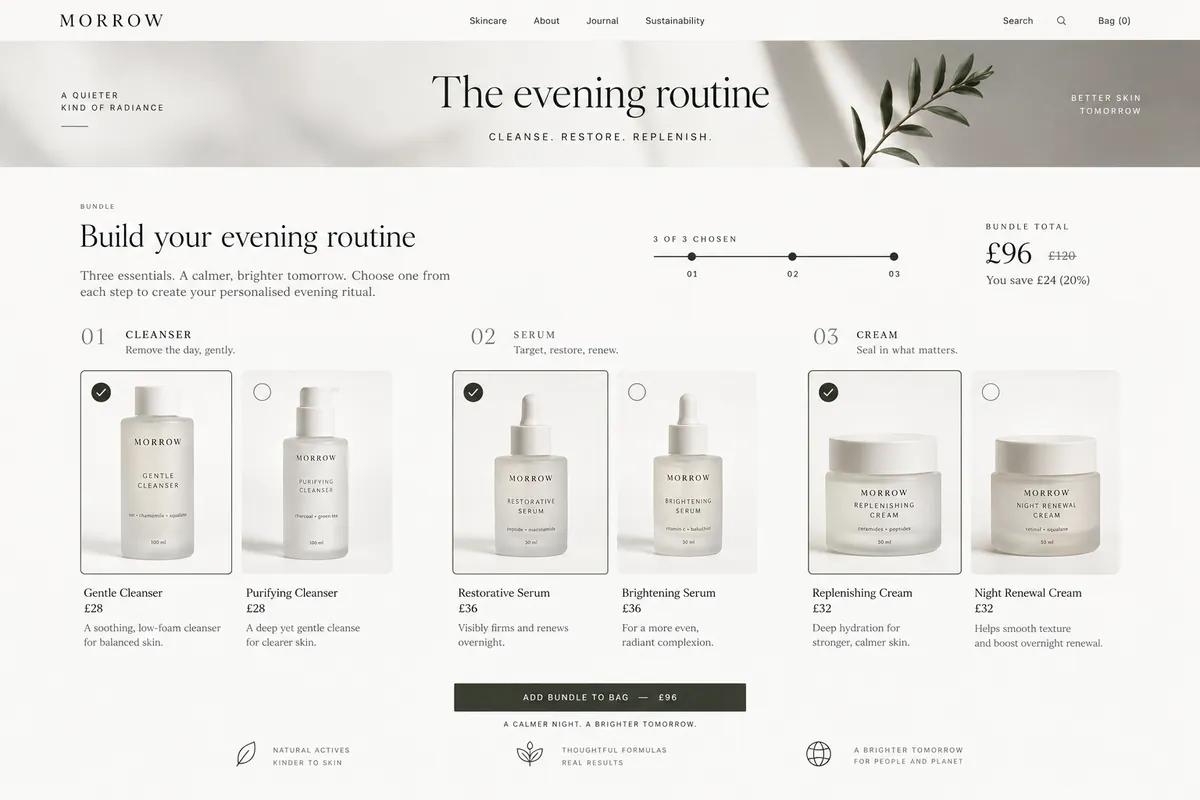
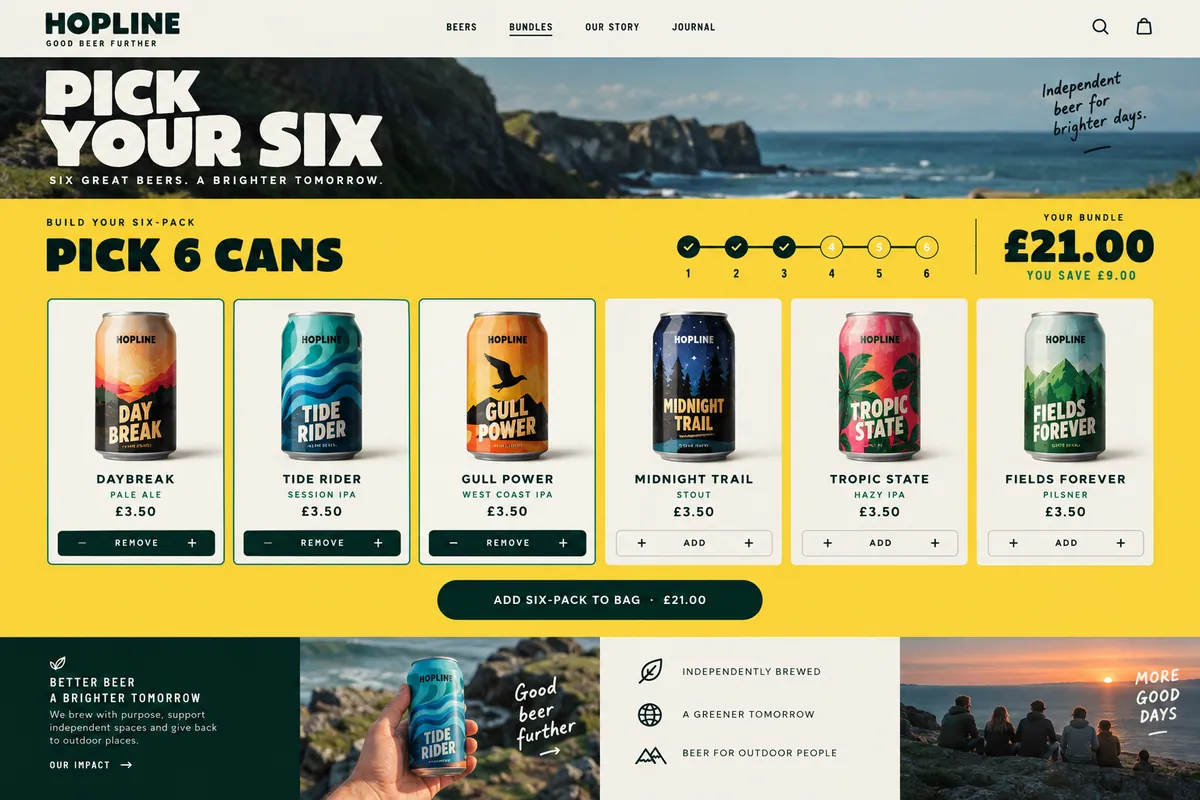
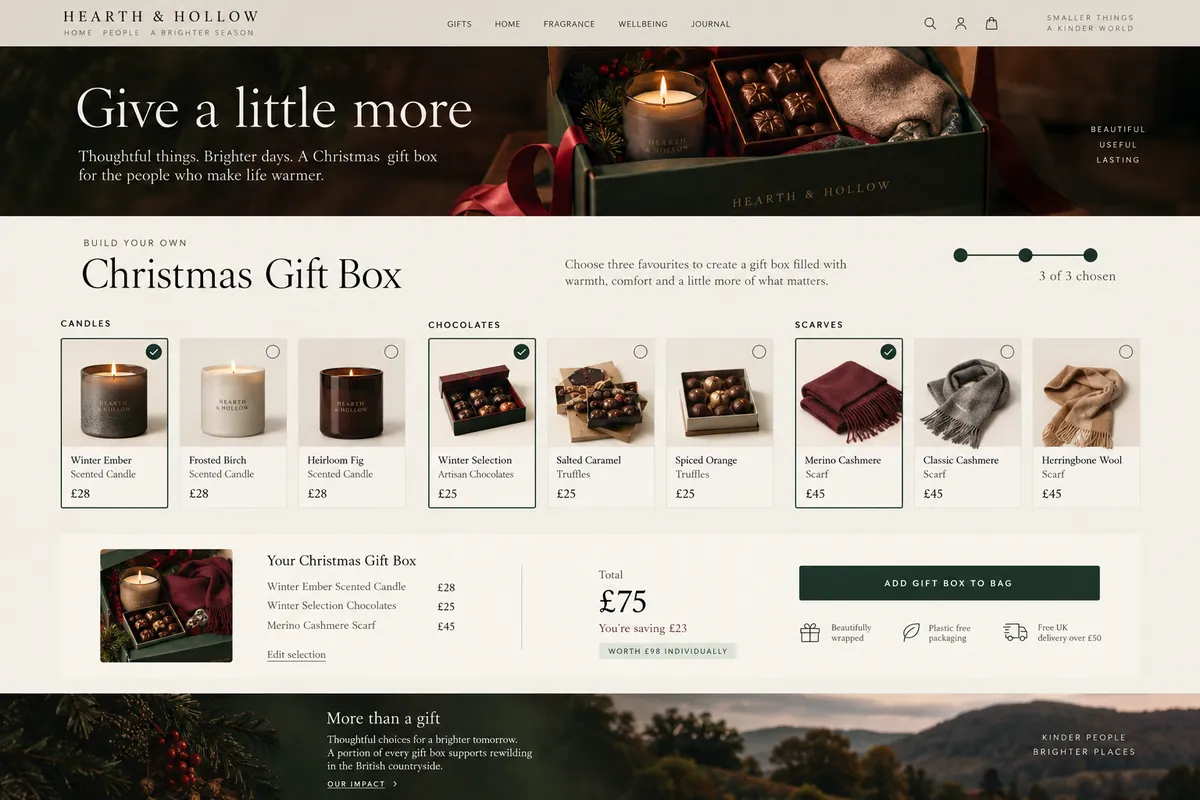
We build them too, and we are proud of how they look. A skincare routine, a pick-your-six beer box, a Christmas gift box, a camera kit: the pages below are the kind of thing Kitenzo renders every day, from a drag and drop builder, from an SDK, or from a conversation.

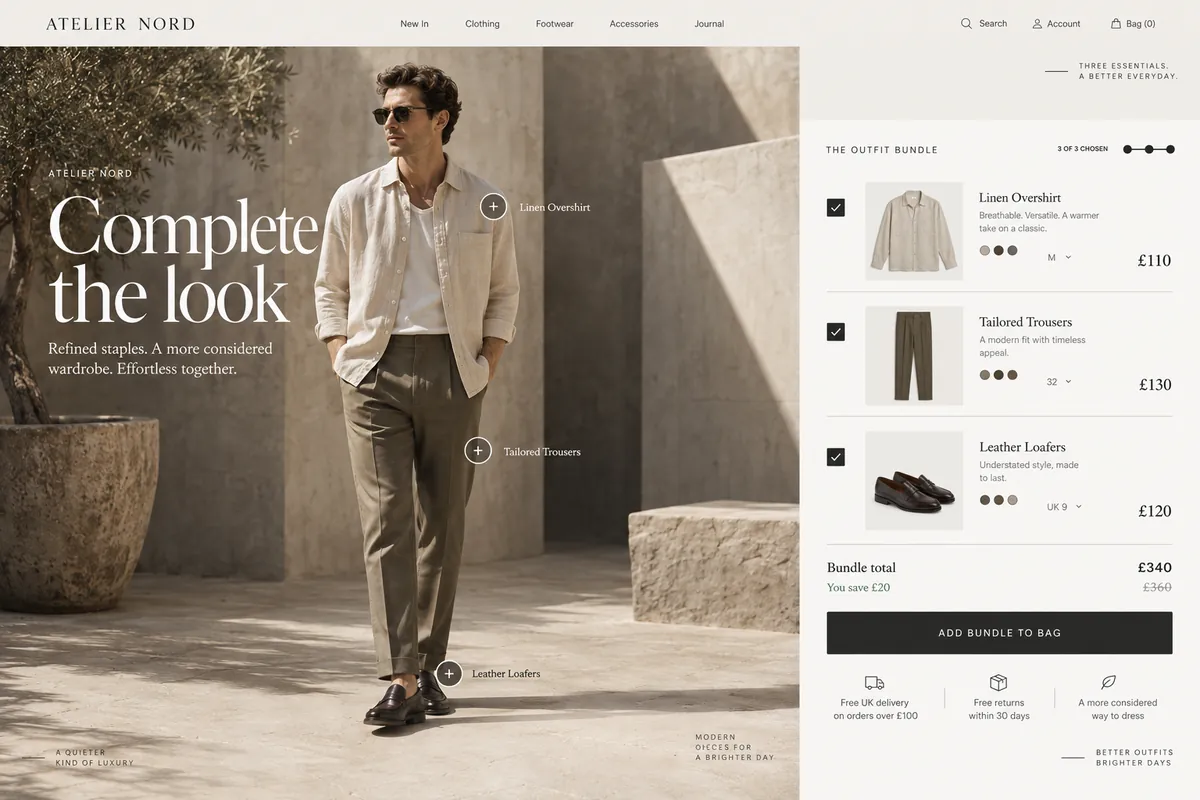
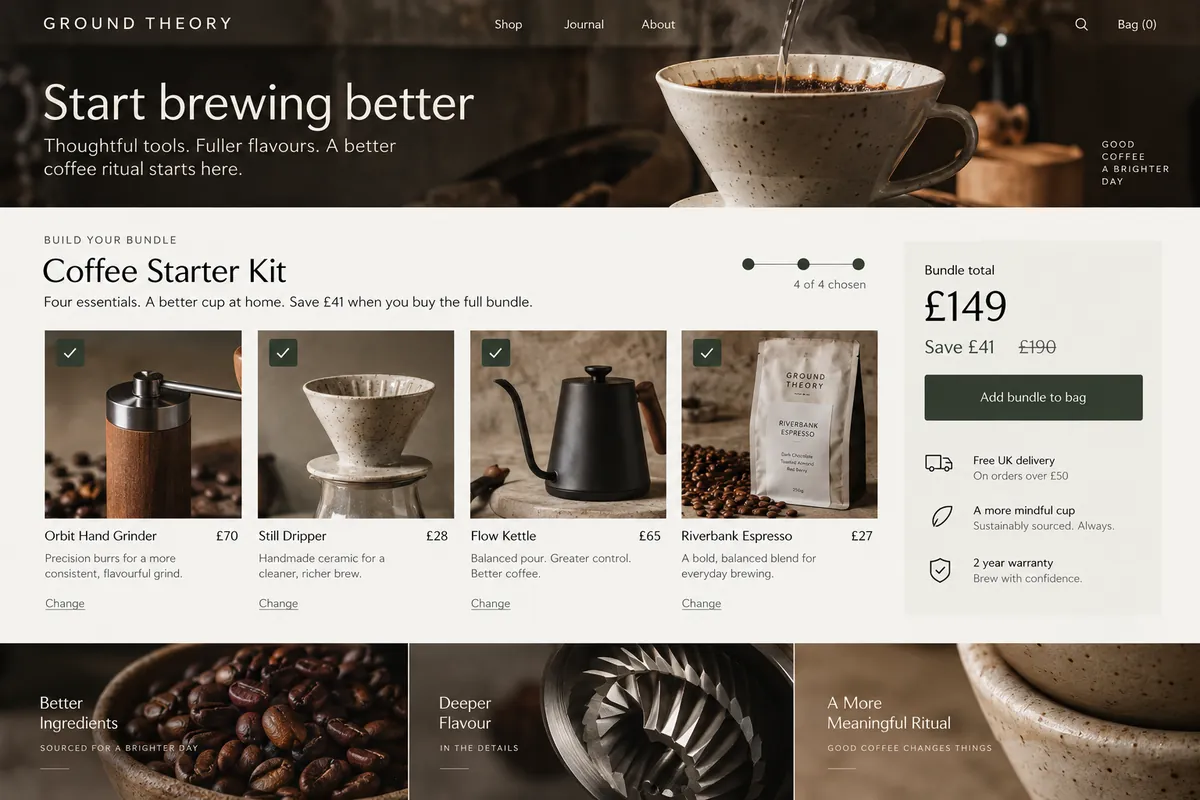
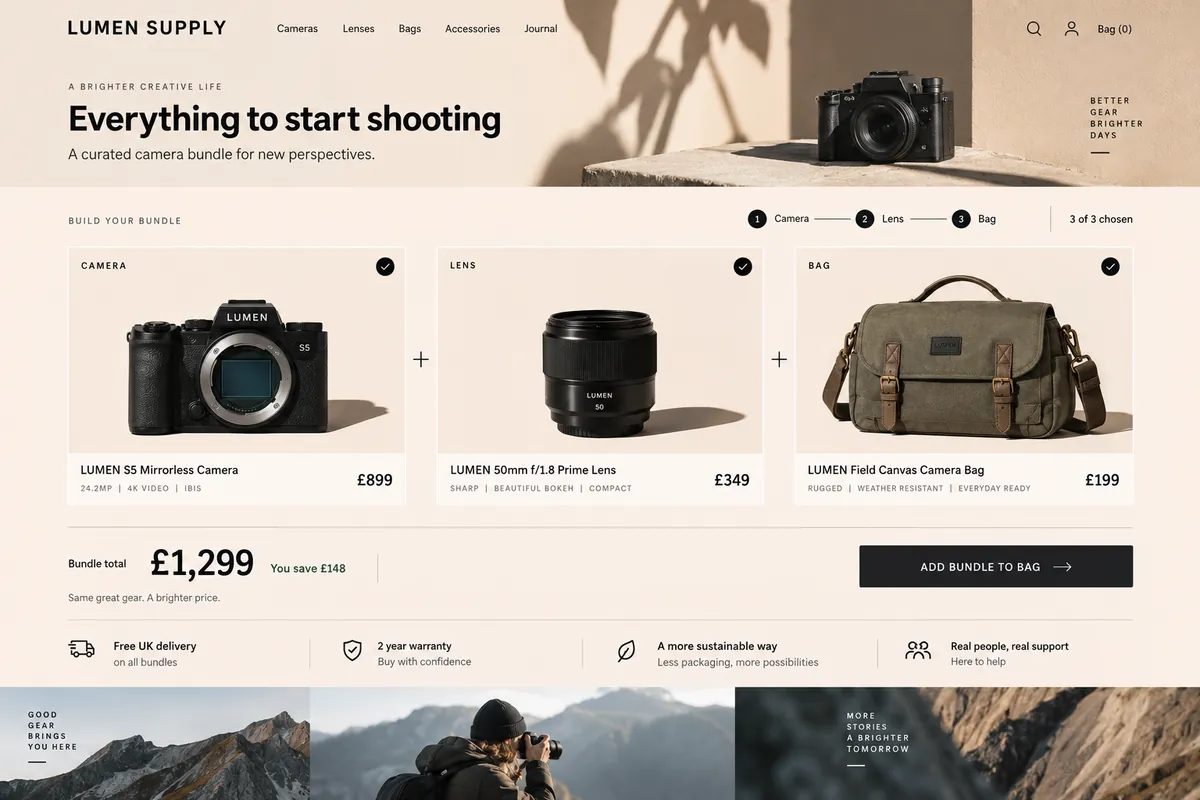
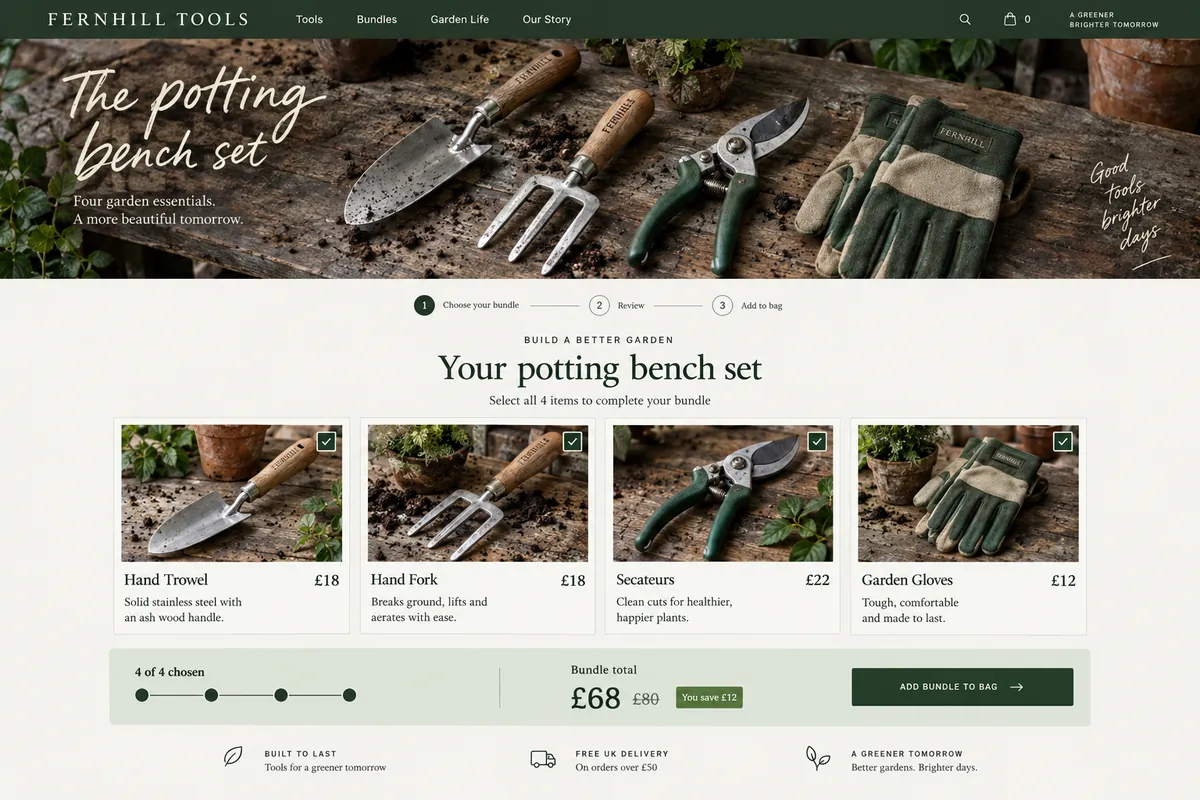
So what are you buying?
If every tool can make the page, the page is not what separates one from another. What separates them is everything the page does not show: whether these are the right products, at the right price, in the right order, and whether anyone would notice if they stopped being right.
That sounds like an opinion. It is closer to a summary of the literature. Economists have studied bundling since the 1960s and consumer psychologists since the 1980s. We went back through the work that matters most to a merchant, and the striking thing is what it is about. It is about which products go together, who values them, what they cost to supply and how the price is framed. Layout is almost absent.
Why bundling works at all
The modern theory starts with a court case. In 1962 the United States Supreme Court ruled against film distributors who sold films only in fixed packages, a practice called block booking. The Court’s reasoning was that distributors used popular films to force weak ones on buyers. The economist George Stigler replied in a short 1963 note in the Supreme Court Review that this could not be the explanation. If a buyer will pay $10,000 for a hit, adding a film the buyer does not want cannot make the package worth more than $10,000. Something else had to be going on.3
His answer was that buyers differ. One values the drama more, another the comedy. Sold singly, each film has to be priced low enough for the buyer who likes it least. Sold together, the differences cancel out.
In 1976 William Adams and Janet Yellen turned the insight into a general model and named the three options a seller has.4 Pure components means selling each product only on its own. Pure bundling means selling only the package. Mixed bundling means offering both: the package at a discount and the single products at full price. Richard Schmalensee extended the analysis in 1984 to the more realistic case where customers’ valuations are spread along bell curves, and described the core mechanism as a reduction in the diversity of buyers: people differ less in what they will pay for a package than in what they will pay for its parts.5
This is the first place the theory tells a merchant something practical. The mechanism only works if the products in the bundle are valued differently by different customers. Put two products together that the same people love and the same people ignore, and there is nothing to even out. The discount is simply given away.
Mixed or pure?
For years the textbook answer was that mixed bundling is always at least as good as pure bundling, because it gives the seller more prices to set. Stefan Stremersch and Gerard Tellis reviewed the marketing, economics and law literature in 2002 and corrected this. In their synthesis, mixed bundling earns more than pure bundling only when customers differ in what they would pay for the bundle as a whole; where they do not, bundle-only does at least as well. In competitive markets, which is where most online stores live, they argue mixed bundling wins.6
The same paper draws a line that is useful to keep in mind. Price bundling is selling separate products together at a discount, with nothing else changed: a six-pack, a luggage set. Product bundling is combining products so that the whole is worth more than the parts, as with a routine whose steps are designed to work together. A price bundle needs a discount to give anyone a reason to buy it. A product bundle may not.6
There is field evidence as well as theory. Timothy Derdenger and Vineet Kumar studied the handheld video game market, where consoles were sold alone and in bundles with games. They estimate that mixed bundling brought in more hardware and software revenue than either selling only bundles or selling only single products, that shoppers treated a bundle as a product in its own right, and that removing the bundles would have led some buyers to delay purchasing.7
Why physical goods are harder
Yannis Bakos and Erik Brynjolfsson showed in 1999 why very large bundles of digital goods (a streaming catalogue, a software suite) are so profitable: the more items in the bundle, the more predictable each customer’s total valuation becomes. They are explicit that this result largely does not carry over to physical goods, because every unwanted item in a physical bundle still costs money to make and ship.8
For a merchant selling things in boxes, that is the second practical lesson. A streaming service loses nothing when you ignore a film. A coffee roaster pays for every bag. Each product in a physical bundle has to earn its place.
When a bundle is worth less than its best product
The economic models assume that adding a product a customer values even slightly can only raise what they will pay for the package. Consumer researchers tested that assumption and found it can fail.
Kimberlee Weaver, Stephen Garcia and Norbert Schwarz call the pattern the presenter’s paradox. People putting an offer together think like adders: every extra is a plus. People judging an offer think like averagers: they form one overall impression, and a mediocre extra drags it down. In their first study, shoppers recruited online said they would pay $242 on average for an iPod Touch with a cover, and $177 for the same iPod Touch and cover with one free music download added. Meanwhile 11 of the 12 people asked to design the package chose to include the download.9 The paper reports the same pattern across seven studies, including hotel advertisements and scholarships.
Aaron Brough and Alexander Chernev found a related effect with price tiers. When an expensive item is combined with a cheap one, people sort the two into categories, “expensive” and “inexpensive”, and the cheap label rubs off on the pair. Across five studies they report that people were willing to pay less for the combination than for the expensive item alone.10 Kellogg’s summary of the work puts the drop at as much as 45% in some cases, and reports that pairing a home gym with a fitness DVD cut the share of people choosing it over a gym membership by 31%.11
A third finding concerns what happens after the sale. Dilip Soman and John Gourville showed that a single bundled price loosens the mental link between what was paid and each item received. In their experiments, people who imagined holding a four-day ski pass were less likely to ski on the last day than people holding four one-day tickets at the same total cost, and a field study of theatre-goers found the same pattern in real attendance.12 For a subscription box this cuts both ways. One simple price is easier to say yes to, but products that go unused are a reason to cancel.
| Study | What was compared | Result |
|---|---|---|
| Weaver, Garcia and Schwarz (2012) | iPod Touch and cover, with or without one free music download | Willingness to pay fell from $242 to $177 when the download was added 9 |
| Brough and Chernev (2012) | An expensive item alone, or combined with an inexpensive one | People paid less for the pair than for the expensive item alone; up to 45% less in some cases 10 11 |
| Soman and Gourville (2001) | A four-day ski pass, or four one-day tickets | Bundled buyers were less likely to use the last day 12 |
Anyone can make the bundle. The work is knowing which bundle to make.
A worked example: the skincare routine
Take the skincare routine from the montage above: a cleanser, a serum and a moisturiser, sold as a set. Any tool will render it well. The research raises four questions that the page cannot answer.
- 01Do customers value these three differently? If one group comes for the serum and another for the moisturiser, the set evens out their valuations and the discount earns its keep, as in Stigler’s example. If everyone wants the serum and tolerates the rest, the set is a discount on the serum.
- 02Should the products also be sold singly? The evidence leans towards yes, particularly where shoppers can compare with other stores. A build-your-own routine goes a step further and lets each shopper sort themselves.
- 03What does the free gift do? Adding a sample sachet or a cheap headband feels generous to the person building the offer. The presenter’s paradox says the shopper may average it in and value the whole set less.
- 04Do the price tiers match? A premium serum beside a budget lip balm invites the “expensive plus inexpensive” sorting that Brough and Chernev describe. The balm may sell better on its own.
Every one of these is a decision about what goes in the bundle and how it is priced. None is a decision about fonts, spacing or photography. Two stores could run identical pages and get very different results because one chose the contents well.
Limits, and what is not known
This literature deserves the same scrutiny as any other, and it has gaps.
The economic models are stylised. Stigler, Adams and Yellen, and Schmalensee study a single seller who knows how customers’ valuations are spread. No merchant knows that in advance. Stigler’s account of block booking itself has been challenged: Roy Kenney and Benjamin Klein argued in 1983 for a different explanation of the practice.13 The general point that bundles even out differences between buyers has lasted better than the original case.
The behavioural studies are mostly small and hypothetical. The iPod study had 54 participants in total, who said what they would pay and did not spend their own money.9 The ski studies asked people to imagine a holiday. These are respectable experiments, and the effects appeared across several studies in each paper, but we have not found large, preregistered replications of the presenter’s paradox or the price-tier effect. Given how many well-known findings in psychology have shrunk when repeated, the direction of these effects is a better guide than their size.
Stores are not laboratories. A shopper on a product page sees reviews, photographs and a brand they may already trust. Whether a $177 against $242 gap survives all that is not something the published work can tell us. The sensible reading is that these are risks worth testing for in your own store, not laws.
Design is not irrelevant. We are not claiming the page does not matter. A slow or confusing page will lose sales whatever is in the box. Our claim is narrower: once the page is good, which is now cheap to achieve, the remaining differences come from the offer.
The easy part should stay easy
None of this makes the page less important. It has to be fast, it has to be yours, and it has to check out natively. We just think it should be the start of the work and not the end of it.
Knowing which bundle to make is a different kind of problem. It is not design and it is not engineering. It is closer to behavioural science: watching what people actually choose when they are given a choice, and changing the offer in response. It is the problem this lab exists to work on. The literature gives the questions. Only a store’s own customers can give the answers, which is why Kitenzo lets a merchant run one version of a bundle against another and see which is chosen, and why our other research is about reading those choices well.
References
- 1Shopify (2026). Shopify Bundles (app listing, viewed November 2026). Shopify App Store.
- 2Shopify (2025). Shopify Editions, Summer ’25. Shopify.
- 3Henderson, D. R. (ed.) (n.d.). George J. Stigler (biography, summarising Stigler’s 1963 note on block booking in the Supreme Court Review). The Concise Encyclopedia of Economics, Econlib.
- 4Adams, W. J. and Yellen, J. L. (1976). Commodity Bundling and the Burden of Monopoly. The Quarterly Journal of Economics, 90(3), 475 to 498.
- 5Schmalensee, R. (1984). Gaussian Demand and Commodity Bundling. The Journal of Business, 57(1), S211 to S230.
- 6Stremersch, S. and Tellis, G. J. (2002). Strategic Bundling of Products and Prices: A New Synthesis for Marketing. Journal of Marketing, 66(1), 55 to 72.
- 7Derdenger, T. and Kumar, V. (2013). The Dynamic Effects of Bundling as a Product Strategy. Marketing Science, 32(6), 827 to 859.
- 8Bakos, Y. and Brynjolfsson, E. (1999). Bundling Information Goods: Pricing, Profits, and Efficiency. Management Science, 45(12), 1613 to 1630.
- 9Weaver, K., Garcia, S. M. and Schwarz, N. (2012). The Presenter’s Paradox. Journal of Consumer Research, 39(3), 445 to 460.
- 10Brough, A. R. and Chernev, A. (2012). When Opposites Detract: Categorical Reasoning and Subtractive Valuations of Product Combinations. Journal of Consumer Research, 39(2), 399 to 414.
- 11Kellogg School of Management (n.d.). When Two Products Are Less Than One (research summary of Brough and Chernev). Kellogg Insight.
- 12Soman, D. and Gourville, J. T. (2001). Transaction Decoupling: How Price Bundling Affects the Decision to Consume. Journal of Marketing Research, 38(1), 30 to 44 (link is to the Marketing Science Institute working paper version).
- 13Kenney, R. W. and Klein, B. (1983). The Economics of Block Booking. The Journal of Law and Economics, 26(3), 497 to 540.